The short answer
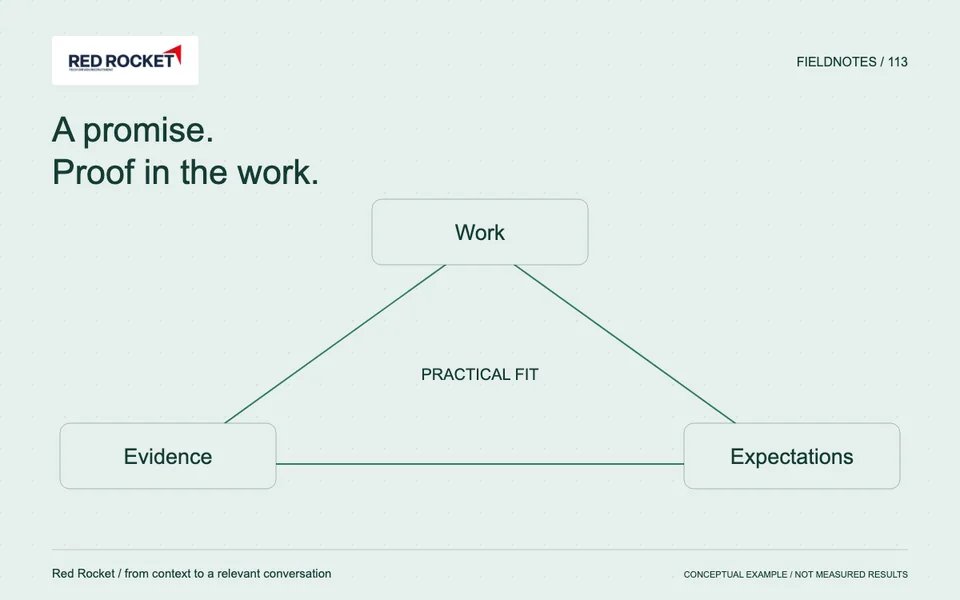
An employer value proposition explains what someone can expect from working with you and what evidence supports it. Check this with employees and managers, then connect it to the work, autonomy and support available in the specific role.
Bring your role, region and essential criteria. In 30 minutes, we explore how to reach technical people who are not actively looking and which approach could fit your vacancy.
The wrong question costs you the best candidates
Reaching more engineers is a reasonable recruitment question. The better question: why would they choose your company? A project manager with twelve years of experience has options. They do not respond to a job posting that promises 'challenging work in a dynamic environment'. They want to know what to concretely expect: how much autonomy, what type of projects, what support. Without those answers, it becomes harder for a candidate to assess the role.
Evidence lives in your current team, not in your head
Talk to current employees across different roles and their line managers. Choose a practical first group; a fixed interview count does not establish representativeness. Ask three questions: what do you tell friends about working here? What made you stay past year one? What would make you leave?
Compare the external promise with the internal reality: where do they match, and where is evidence missing? Check whether your view as an employer matches employees’ experience. Use their words, not your marketing department's. Those words are more credible, more specific, and more recognizable to the candidate reading them.
Three pillars that move technical professionals
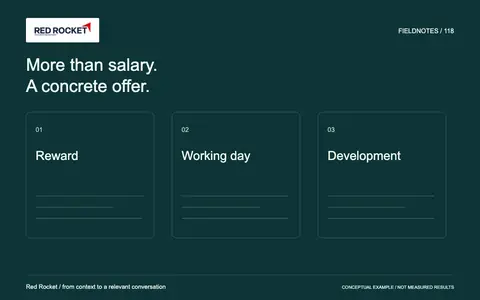
Use three work-related themes, for example, to make the promise concrete:
- Autonomy. Can a project manager make real decisions, or does everything escalate to management?
- Project type. Complex and varied assignments, or standardized and predictable work?
- Support. What tools, colleagues, and guidance are actually available?
Be specific across all three. 'Challenging projects' means nothing. 'Commercial renovation projects between €500K and €3M with a dedicated crew of eight and a weekly project review with the director means something. Candidates reading that know immediately whether it fits.
Fictional example: how Vroon & Partners built their employer promise
This is an invented scenario, included as illustration only. Imagine that Vroon & Partners, a fictional installation company, interviews three senior project managers before writing anything down. All three independently name the same things: they can approve quotes up to €50K on their own, they work on non-residential construction with a fixed crew, and the director personally steps in when a project stalls. Those become three concrete promises in the job posting and recruitment campaign. Not marketing copy. Evidence from the inside.
Each role has a different emphasis. Honesty pays off.
A project manager focuses on autonomy and responsibility. A BIM modeller wants to know which software you use and how quickly updates are adopted. A construction planner wants a clean handover from the design phase and clear specifications. An engineer looks for technical depth and good sparring partners.
Be honest about what you do not offer. If hybrid working is not realistic for field roles, say so before the second interview. This lets candidates compare their expectations with the working reality earlier in the process.
For further reading on employer brand strategy: CIPD Recruitment Brand Factsheet. Want to discuss your own vacancy? Book a call with Red Rocket.
Frequently asked questions
How do I know if my employer value proposition is strong enough?
Show it to three current employees and three people who recently declined your offer. If the first group nods and the second says 'that is not what came across', you have work to do.
Do I need a separate EVP for every technical role?
Not necessarily. One core promise, different emphases. The project manager reads about autonomy, the BIM modeller reads about software. Same employer, different entry point.
What if our employer promise honestly is not that strong?
That is the moment to improve, not to repackage. Candidates see through polished copy. Honesty about your limitations builds more trust than promises that do not hold up.