The short answer
Examine how recurring the work is, who manages it and which knowledge must be retained. Ongoing work with long-term responsibility may suit permanent headcount. A temporary peak may be a reason to compare project capacity. The appropriate route also depends on availability, guidance, costs and the arrangements for delivery and handover.
Bring one vacancy. In 30 minutes, we discuss where your recruitment is getting stuck, which approach could fit and your recruitment fee.
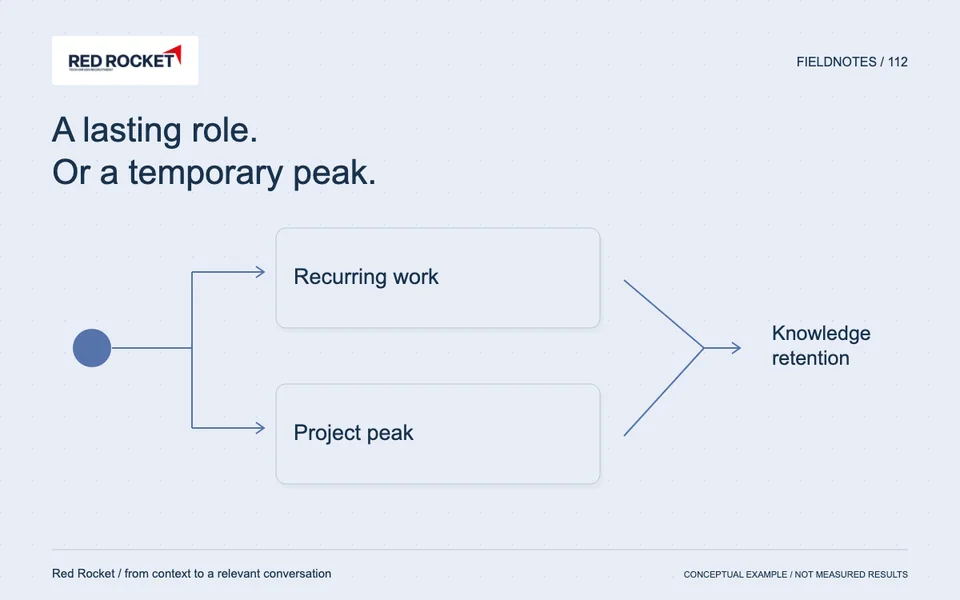
The core question: recurring work or temporary peak?
Not every capacity question is the same. A site preparation engineer who consistently manages projects builds knowledge you cannot afford to lose when a contract ends. A calculation exercise for a single tender has a clear end date. Ask yourself first: will this work still be needed in two years? If the answer is yes, permanent headcount is an option to examine closely.
Knowledge retention: what disappears when someone leaves?
With project capacity, you deliberately plan for a handover. But in practice, knowledge loss is a risk during any handover: client relationships, project history, internal ways of working. A practical example: a construction firm brings in external capacity for a BIM project. Afterwards, internal knowledge of the model turns out to be limited. Who retains what, and when, must be agreed upfront – not sorted out afterwards.
Management and mandate: who is responsible?
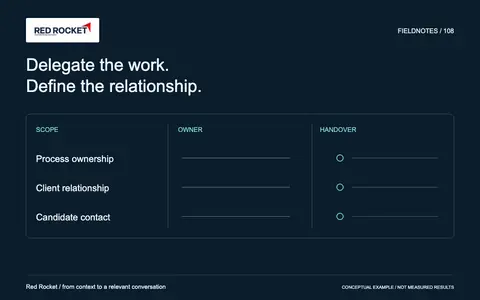
Permanent employees fall under your management and organisational culture. Project capacity requires clear agreements on who issues instructions, who handles escalations, and what mandate the external person holds. Without that clarity, grey areas emerge. The larger the project and the longer the duration, the more that management structure needs to be on paper before work begins.
Decision route: four questions that set the direction
Use these four questions as a guide:
- How long does the work last? Shorter than six months points towards project capacity.
- How critical is knowledge retention? High risk calls for permanent staff or an explicit handover plan.
- Who manages the work? Internal mandate is sometimes absent with temporary hires.
- What is the budget and decision authority? Align the approach with what can be approved internally.
Connect the capacity decision to your recruitment needs
Red Rocket connects campaigns, the AI recruiter and organisational context with insight in Cockpit for your personal follow-up. If permanent recruitment fits the capacity decision, we discuss the role and approach. Do not assume temporary staffing services or a particular integration. Discuss a role for your ongoing staffing needs. Read UWV on workforce demand in construction for sector context.
Frequently asked questions
Can you start with project capacity and convert to permanent later?
That can be a deliberate strategy: the person learns the organisation and you learn the person. If so, agree upfront on the conditions for a potential permanent role, so expectations on both sides are aligned from the start.
What if the internal mandate is unclear?
Then that is the first problem to solve – before you recruit or hire. Without a clear mandate, a new employee or external person does not know what they are allowed to decide. That leads to delays and frustration, regardless of whether it is permanent staff or project capacity.
How do you assess whether the cost of permanent recruitment outweighs hiring in?
Compare total costs over the expected duration: recruitment costs, onboarding time, and knowledge build-up for permanent staff versus hourly rates, management time, and handover risk for external capacity. Red Rocket works on a no cure no pay basis from 11% of annual salary as standard; further terms and basis are agreed upfront.