The short answer
Look at each project's phase, the decision-making capacity required, and the desired start date. Translate that into a recruitment calendar with one priority vacancy at a time. Build in a delay scenario: what if a project shifts by three months? Planning capacity is not about counting job ad leads – it is about having the right people available at the right moment.
Bring one vacancy. In 30 minutes, we discuss where your recruitment is getting stuck, which approach could fit and your recruitment fee.
From project phases to recruitment moments
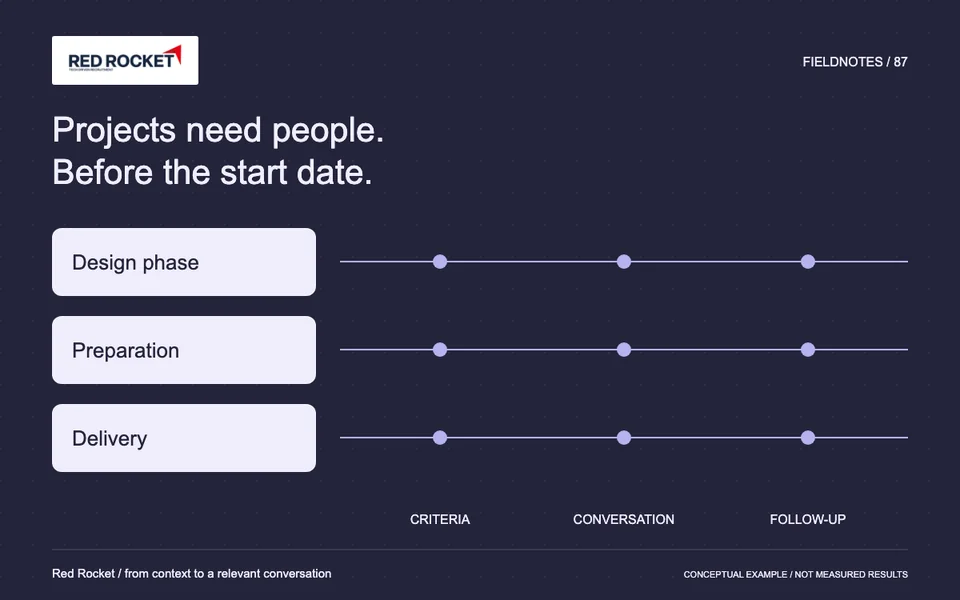
Start with your project portfolio, not a vacancy list. Every project has phases: preparation, execution, delivery. Each phase requires different people at different times. Map those phases side by side and mark where decision-making capacity is needed. That gives you a recruitment calendar grounded in reality, not administrative wishful thinking.
One priority vacancy at a time
Recruiting everything at once means recruiting nothing well. Choose one vacancy per quarter that carries the most weight for your current portfolio. Identify which role could block a project if not filled on time. That role takes priority: in attention, budget, and lead time. The rest follows in order of project risk.
Delay scenario: what if a project slips?
Suppose a major project runs three months late. The project manager you wanted to start in September is now not needed until December. Build this scenario in from the start. Agree in advance how you will retain a strong candidate in the interim, or when you will restart the recruitment process. That way a timing problem does not cost you the right person.
Decision-making capacity is not advertising volume
Capacity planning is about the people who make decisions, not the number of vacancies posted online. A estimator or planner missing during the preparation phase costs far more than an empty job ad. Map which roles carry project decisions and plan recruitment accordingly. UWV notes that replacement demand in construction remains substantial even as job growth slows.
Get started with Red Rocket
Red Rocket combines campaigns, an AI recruiter, and organisational context in one Cockpit. You can see at a glance where each candidate stands and when you need to act. Personal assessment and follow-up interviews remain with your recruiter or hiring manager. Want to translate your project portfolio into a concrete recruitment plan? Book a conversation and read the UWV construction analysis on replacement demand and scarce roles.
Frequently asked questions
How far in advance should I start recruiting for a new project phase?
Allow at least eight to twelve weeks for a specialist in a tight market. Factor in onboarding: someone who starts in week one rarely operates at full capacity for several weeks. Begin earlier than you think necessary.
What do I do when two projects simultaneously need the same key role?
Make an explicit choice based on project risk and revenue weight. Recruiting for two identical roles at once rarely speeds things up – it divides attention. Consider whether one candidate can temporarily support both projects while the second search runs.
How do I keep my recruitment plan current when projects shift?
Link your recruitment calendar to your project planning and review it monthly. Set a fixed moment to reassess start dates, priorities, and open processes. That way you avoid recruiting for a project that has already been postponed.