The short answer
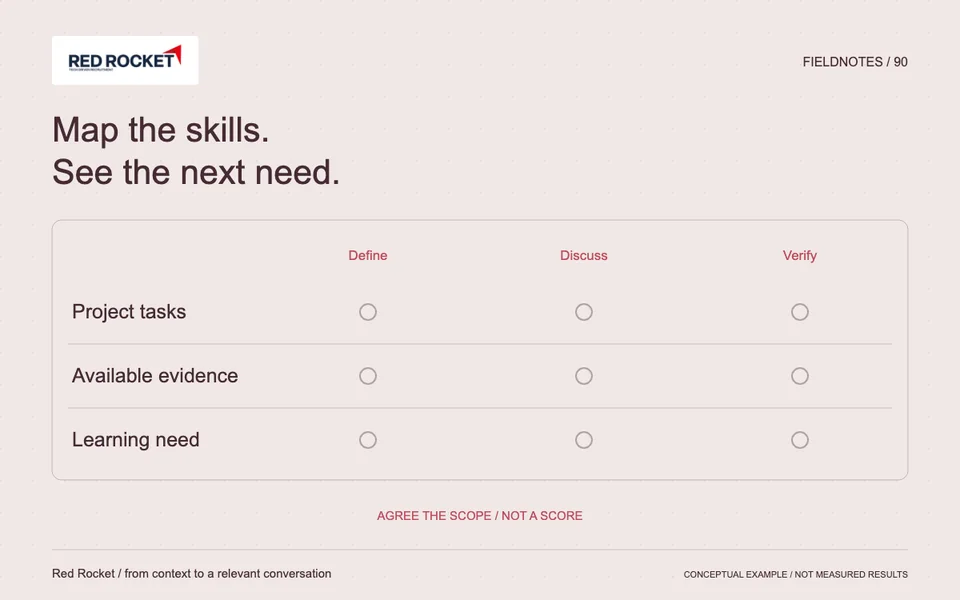
Start with the project tasks your team actually performs. Translate those into observable skills, establish the current evidence level for each person and flag where a learning need or a vacancy is the priority. A shared language such as CompetentNL helps with naming skills consistently, but does not replace a substantive assessment by the team leader or subject-matter expert.
Bring your vacancy. In 30 minutes, we discuss which questions reveal experience, motivation and availability, and how you take the personal follow-up forward.
From project tasks to observable skills
A skills matrix does not start with a competency dictionary – it starts with the work itself. Write down the five to ten recurring project tasks your technical team carries out: think drawing reviews, planning coordination or calculating variations. Translate each task into the skill someone needs to perform it independently. The result is a matrix that the people in it will actually recognise.
Recording current evidence for each team member
For each skill, assess what the current evidence is – not what someone claims to be able to do. Consider completed projects, tasks performed under supervision or training with demonstrated practical application. Use a straightforward scale: no experience, developing, independent, able to coach others. The team leader or subject-matter expert establishes this in conversation with the team member, not from a form alone.
Marking learning needs and recruitment priorities
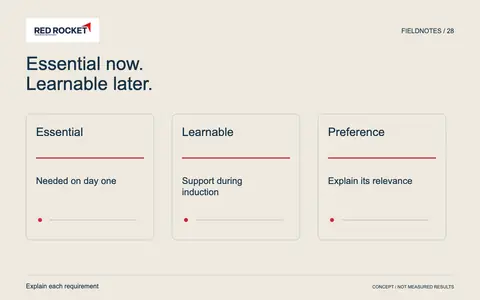
Once current levels are visible for each person, the gaps become clear. Mark each skill gap as either addressable internally through coaching or training, or requiring a new colleague. This turns the matrix into a practical tool for both HR and the line manager, without it becoming a bureaucratic document that nobody maintains.
CompetentNL as a shared language
CompetentNL provides a standardised skills taxonomy also used in CBS research on online vacancies. It is a tool for consistent naming, not an automatic assessment standard and not a certificate. Whether a team member has mastered a skill remains a substantive judgement by the people who know the work. Use the taxonomy as a reference, not as a final verdict.
Connecting the matrix to recruitment and organisational context
A completed matrix makes a vacancy profile more concrete and more honest. Red Rocket uses organisational context to align campaigns and the AI recruiter with what your team genuinely needs. Want to know how to use the matrix as a starting point for recruitment? Book a conversation and consult the CBS publication on skills in online vacancies for broader labour market context.
Frequently asked questions
How often should the matrix be updated?
That depends on how quickly project tasks evolve. For most technical teams, an annual review is a good rhythm, supplemented by an update when a new vacancy arises or a significant project change occurs.
Is CompetentNL a required framework?
No. CompetentNL is a tool for shared language, not a legal standard. You can use your own framework as long as the skills are observable and recognisable to the team.
Can Red Rocket help build the matrix?
Red Rocket maps organisational context as part of the recruitment process. Whether a full matrix exercise is included in the collaboration is something to agree in advance. Get in touch for a concrete proposal.