The short answer
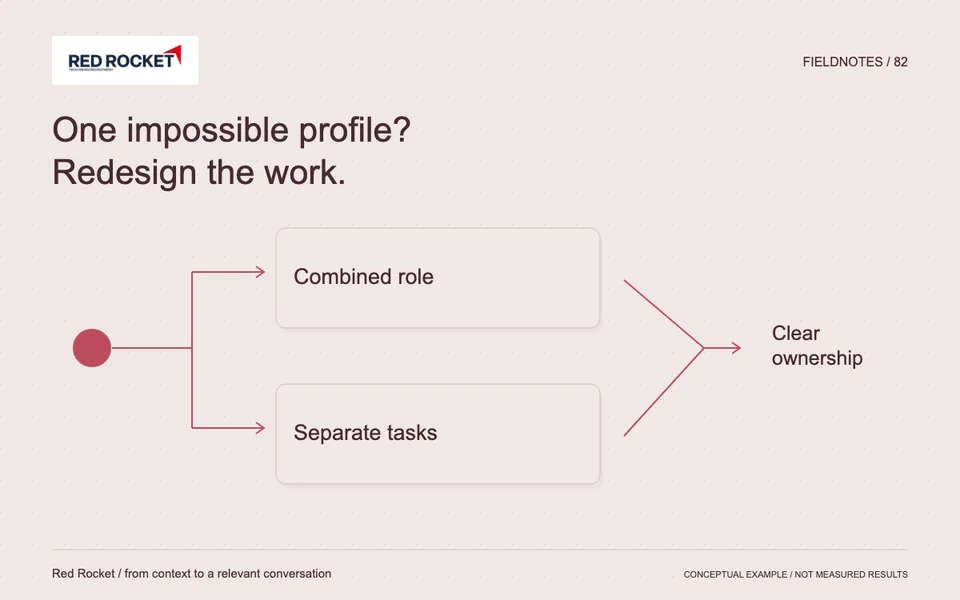
Split a technical role if the combination of responsibilities is not practically manageable by one person. First, analyse which tasks are substantively related, which require a different level of thinking, and where most errors or delays occur. That provides a clear picture of one or two more realistic roles.
Bring your role, region and essential criteria. In 30 minutes, we explore how to reach technical people who are not actively looking and which approach could fit your vacancy.
When is a job profile unrealistic?
A vacancy that combines calculation, work preparation, project management, and administrative processing effectively asks for four different mindsets in one person. Calculation requires analytical thinking under time pressure. Project management requires communication and oversight. That combination exists, but it is rare – and therefore hard to find. The first sign: the vacancy has been open for months without suitable candidates.
Task analysis: how to approach it
List all the tasks the role encompasses. Then group them by three criteria: substantive coherence, required level of thinking, and time spent per week. A hypothetical example: at a medium-sized installation company, calculation and work preparation together take forty hours per week, while project management and reporting cost another thirty hours. That is not one role – those are two.
Splitting is not the same as lowering standards
Redesigning does not mean you are lowering the bar. You are distributing responsibilities more logically across roles that are each realistically fillable. A work preparer with a calculation background and a project coordinator with an administrative focus are both findable. One impossible combined role is not. The quality of the work actually increases when people do what they were hired for.
Two roles or one: how do you decide?
Consider three factors: available budget for two salaries, the size of the project portfolio, and the extent to which tasks must be performed simultaneously. Is the portfolio small and are tasks sequential? Then one strong generalist may suffice. If the portfolio grows or projects run in parallel, investigate whether splitting the role is feasible and necessary. Discuss with Red Rocket which role, organisational context and recruitment approach could fit the work.
Practical first step
Schedule an internal ninety-minute meeting with the direct manager and an experienced colleague from the team. The goal: to name all tasks, cluster them, and honestly estimate how many hours they take per week. That conversation yields more than a generic job profile. Only then do you write the vacancy – or two. Discuss your job profile in a short conversation and view additional solutions for technical staff at uwv.nl.
Frequently asked questions
How do I know if my vacancy is unrealistically composed?
A practical test: ask three colleagues independently how many hours the tasks take per week. If the total consistently exceeds fifty hours, or if the required competencies diverge widely, redesign is worthwhile.
What if we do not have the budget for two roles?
Then the question is which tasks add the most value and which can be assigned elsewhere – to an existing colleague, a freelancer for a partial task, or a junior who takes over one cluster. Redesigning is about smarter distribution, not necessarily about hiring more people.
Does the job profile also change the recruitment strategy?
Yes, significantly. A narrower, more realistic profile attracts more candidates because more people recognise themselves in the role. Red Rocket aligns the campaign and the AI recruiter with the profile you are actually looking for – the personal assessment of candidates remains with you as the employer or recruiter.