The short answer
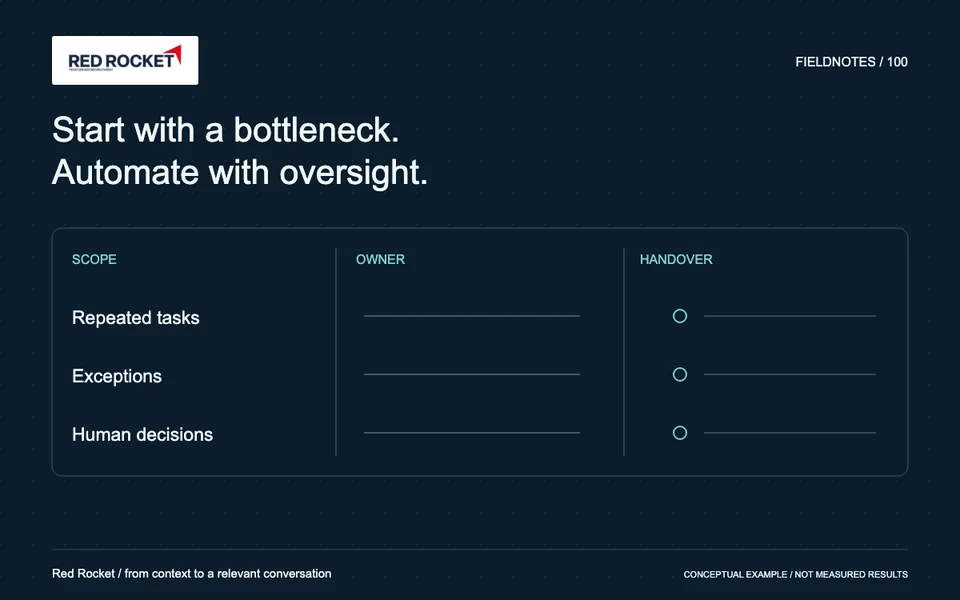
Begin with tasks that are repetitive and require little interpretation: status information, frequently asked questions, and initial information provision. Always leave assessment, selection interviews, and offers to a human. First, identify where the workload is highest and what exceptions you encounter. Solving one bottleneck yields more than broad automation without measurement.
Bring one vacancy. In 30 minutes, we discuss where your recruitment is getting stuck, which approach could fit and your recruitment fee.
Inventory repetition versus interpretation
Not every recruitment task lends itself to automation. For two weeks, write down which questions and actions keep recurring: 'Have I received confirmation?', 'What's the next step?', 'When will I hear something?' These are candidates for automation. Tasks that require context, nuance, or judgment – such as assessing an interview or formulating an offer – remain human work.
Choose one process bottleneck
Fictional example: an HR team of three people at an installation company receives twenty status inquiries per vacancy weekly. They decide to tackle that bottleneck first: automatic status updates after each phase. Only when that is running stably do they look at the next point. Broad automation without focus leads to half-finished processes and more work, not less.
Measure workload and exceptions
Automation only works if you know what you are measuring. Count how much time a task takes, how often exceptions occur, and what goes wrong if automation fails. A status message sent incorrectly damages a candidate's trust. Therefore, always build in a moment for a recruiter to check whether the system is doing what it should.
Human assessment and responsibility
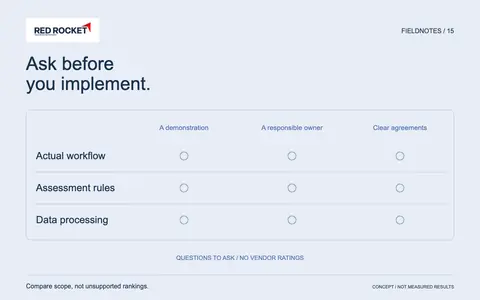
Automation supports the process; the recruiter or hiring manager assesses and decides. Whether a system pre-selects candidates or only informs them is an implementation choice you determine in advance – including who is responsible for the outcome. Record these agreements in writing, also for internal use. This clarifies who does what and who is accountable.
Red Rocket and the Cockpit
Red Rocket combines campaigns, an AI recruiter, and organisational context in one environment. The Cockpit gives the recruitment team an overview of ongoing processes. You configure which tasks within it are automated and which remain with the recruiter. This is not a default setting but a conscious choice. Plan a meeting to discuss what suits your team. More perspective on candidate experience and process design can be found in Recruitee's vision on candidate experience.
Frequently asked questions
Can a system automatically reject candidates?
That is a legal and ethical implementation question. Determine in advance who is responsible for rejections and whether a human checks every decision. Consult your legal advisor on the applicable rules in your sector.
How do you know if automation works?
Measure before and after: how much time does the task take, how many exceptions are there, how many candidates drop out. Without measurement, you don't know if you are progressing or just adding complexity.
What if the automation makes a mistake?
Plan a review point and assign responsibility for investigating and correcting errors and informing candidates when needed. Record when a process should be paused. Without these arrangements, errors may go unnoticed.