
The short answer
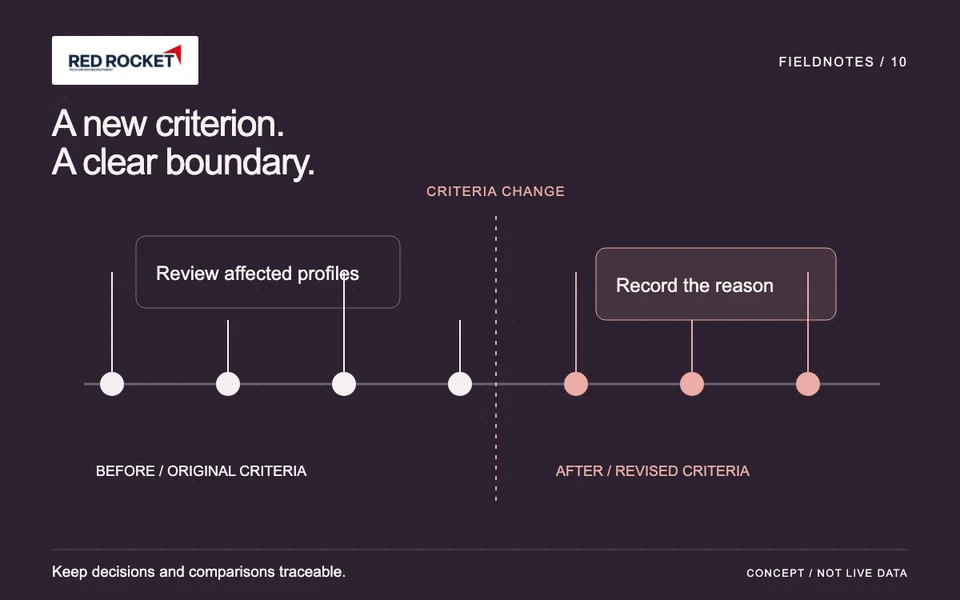
When a hiring manager changes qualification criteria during an active recruitment campaign, a clear approach is essential. Record the original criteria with the date and reason for the change. Assess all candidates consistently against the new requirements – including those already screened. Distinguish between candidates who no longer meet the new criteria and those who previously qualified. No adjustment guarantees a better outcome, but a well-documented process protects both the quality of your selection and the credibility of your recruitment process.
Bring your vacancy. In 30 minutes, we discuss which questions reveal experience, motivation and availability, and how you take the personal follow-up forward.
A mid-process change changes everything
The vacancy is live. You have screened the first candidates, perhaps already conducted interviews – and then the hiring manager announces that the requirements have changed. A new technical skill is now mandatory. Or a previously required qualification has been dropped. At first glance it seems a minor adjustment, but for the recruitment process the consequences are significant.
Candidates you assessed against the original criteria may no longer fit. Or the reverse: people you previously rejected are suddenly qualified after all. Without a clear approach, you lose control of the consistency of your selection – and with it, the quality of the entire process.
Log the original criteria before you proceed
The first step with any change to criteria is documentation. Record the original qualification criteria, along with the date of the change and the reason the hiring manager gives. This creates a version history of the job requirements – simple, but indispensable.
Without that record, you cannot demonstrate afterwards which criteria applied when you assessed a particular candidate. That is not merely an administrative shortcoming: it also undermines candidates' trust and the internal credibility of your recruitment process. A concise change log – date, old requirement, new requirement, reason – is the bare minimum to maintain.
What happens to candidates already screened?
This is where the greatest challenge lies. Candidates you assessed against the old criteria now fall into three groups: those who still qualify under the new requirements, those who no longer qualify, and those you previously rejected who now do qualify.
Each group calls for different handling, but the approach must be consistent across all candidates. Without that consistency, you are comparing like with unlike. A candidate you reject on the basis of a requirement that did not exist three weeks ago deserves at least a fair reconsideration.
There is a further complication: interviews already conducted were based on the old line of questioning. Notes from those conversations are therefore not fully comparable with interviews conducted after the change. Recording the screening date alongside the criteria in force at that time makes a partial comparison at least possible.
Reconsidering consistently – without making promises
If you decide to apply the new criteria to the ongoing process, do so consistently. Re-assess all active candidates in the same way. Adjust the interview structure so the new requirements feature in subsequent conversations. This takes time, but it preserves comparability between candidates.
What you cannot promise is that the adjustment will lead to a better outcome. A broader requirement may attract more candidates, but not necessarily stronger ones. A stricter requirement narrows the pool without guaranteeing higher quality. The change affects the process – the result is ultimately determined by the candidate market.
This is a recommended process. Check which records and reports your supplier supports; this article does not promise automatic versioning or reassessment in Cockpit.
Would you like to think this through for your vacancy?
A change to criteria mid-campaign is not always avoidable. Roles evolve, circumstances change, and sometimes the hiring manager has good reasons to move the goalposts. What you can control is how you manage that process – fairly, traceably, and professionally.
If you are in the middle of this situation, or want to think through how to handle it in a future campaign, book a conversation. We will look at your specific situation together and work out an approach that fits.
Frequently asked questions
Must every candidate be reassessed?
Identify which candidates are affected by the substantive change. Treat comparable situations consistently and record what additional information is needed. A missing new answer is not automatically a failed criterion.
What if someone already has an offer?
Do not change an offer because of a new selection preference without assessing the arrangements and consequences. Involve HR and legal advice where needed; the specific situation determines what is possible.
How do I prevent criteria from changing mid-campaign?
You cannot always prevent it – roles and organisations change. What you can do is agree a criteria freeze at the start of the campaign: the hiring manager confirms the requirements in writing before the vacancy goes live. This reduces the likelihood of mid-process changes and gives you a clear baseline if something does change.