
The short answer
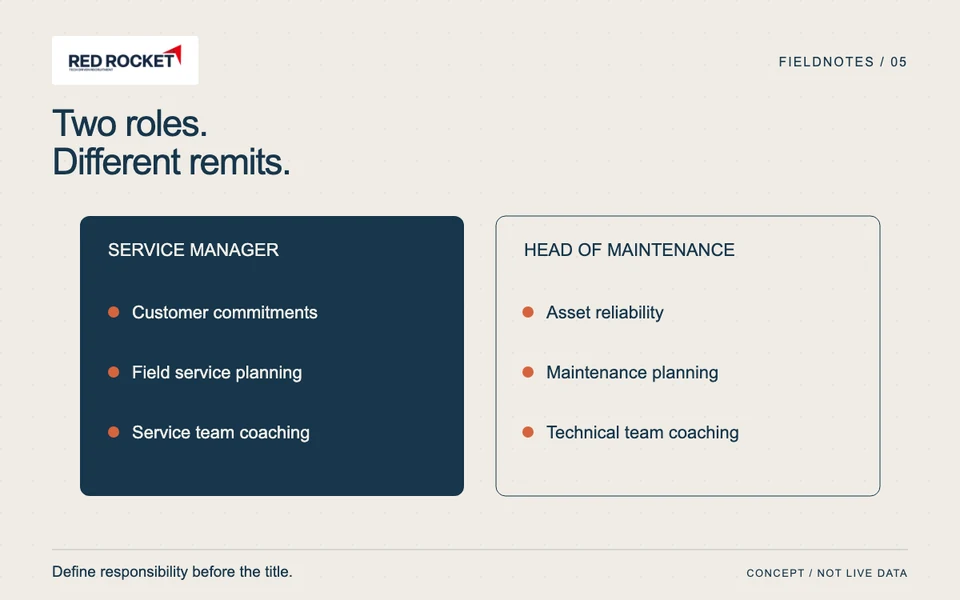
A service manager often focuses on customer service, scheduling and coordination with field teams. A head of maintenance often focuses on maintenance, reliability and the technical organisation around a company’s own equipment. Titles and duties differ between businesses and may overlap. Describe the work, responsibilities and authority first, then choose a recognisable title.
Bring your role, region and essential criteria. In 30 minutes, we explore how to reach technical people who are not actively looking and which approach could fit your vacancy.
Start with the problem the new colleague will solve
Customers are waiting for updates, service scheduling is overloaded or recurring faults remain unresolved. These are different problems. An appealing job title alone does not establish who should address each one.
Ask the manager which decisions the new employee must make. Is the focus customer commitments, allocating technicians, maintenance strategy or a combination? Also describe which tasks remain with other colleagues.
Two fictional work contexts
Fictional example A: an installation company needs someone to manage customer commitments, coordinate scheduling with technicians and monitor service quality. Service manager may be a suitable title if the vacancy also explains the technical responsibilities.
Fictional example B: a manufacturer needs someone to prioritise maintenance, investigate recurring faults and lead the technical team. Head of maintenance may be a recognisable title. These examples are not fixed occupational definitions.
Compare the responsibilities
- Customer: who discusses expectations, complaints and service agreements?
- Technical work: who decides on maintenance approaches, replacement and technical risks?
- Scheduling: who allocates people, resources and available time?
- Team: who reports into the role and what support will they receive?
- Budget: which decisions can the new employee make independently?
Do not use a fixed customer-contact percentage to determine the title. The actual combination of duties and authority matters more.
Ask for examples that match the actual work
For customer-facing service, ask how someone coordinated a delay with a customer and technicians. For maintenance responsibility, ask how a recurring fault was investigated and what action followed.
Leadership may matter in both roles. Ask about personal contribution and responsibility, not just the team’s result. Avoid assuming a strong technician cannot support customers or a service professional lacks technical depth.
Align the title, campaign and conversation
A combined role may be appropriate, but make time, support and priorities clear. A service coordinator may primarily support scheduling; that title also needs an explanation of the actual duties.
Use the same role definition in the advert, initial conversation and assessment. Discuss the responsibility you need to fill and the relevant audience. A clear role is a better starting point than simply changing the job title.
Frequently asked questions
Can one person cover both roles?
Potentially, depending on scale, complexity and support. Agree priorities and authority and avoid silently combining two full jobs into one vacancy.
Which title generates the most responses?
You cannot establish that in advance. Use a recognisable title that describes the work honestly and assess response suitability, not just volume.
Does a service manager need technical knowledge?
Determine which technical decisions the role makes independently and what expertise is available in the team. That establishes what is essential at the start.