
The short answer
A candidate may also be identifiable through a combination of employer, project, location and career history. Replacing the name does not automatically make text anonymous. Limit input to what the role assessment needs and review indirectly identifying details too. Ask what happens to the original text, filtered input, model output and logs. EU storage does not replace that assessment.
Bring one vacancy. In 30 minutes, we discuss where your recruitment is getting stuck, which approach could fit and your recruitment fee.
A fictional answer before and after filtering
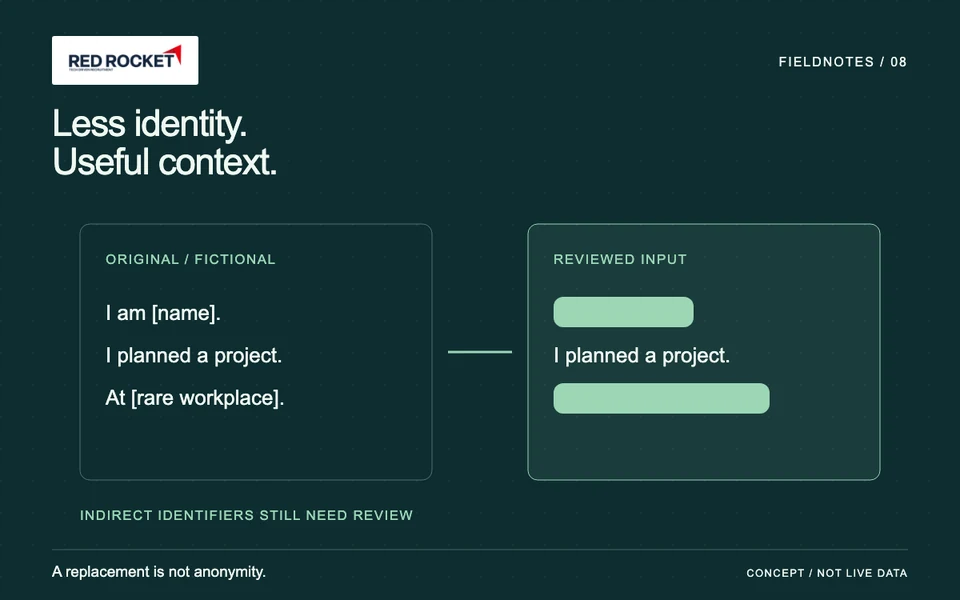
Fictional example: “I am Sam. As the only maintenance coordinator at a small company, I worked on a named project in a named town.” Replacing Sam with a code can still leave details that identify someone.
For a question about maintenance scheduling, a more limited description may suffice: “I coordinated maintenance and aligned the schedule with the installation team.” Check that necessary technical content remains. This example illustrates a judgement, not proven fully anonymous processing.
Pseudonymisation and anonymisation are different
The European Commission explains that data which can be linked back to a person remains personal data. The EDPB distinguishes pseudonymisation from anonymity. Replacing a name or contact detail is not a general exemption from privacy duties.
Which details identify someone depends partly on context and available additional information. Do not use “anonymous” as shorthand for “we removed names”. Describe the actual measure and its limits.
Follow the data flow step by step
- Original text: what arrives and who can access it?
- Filtered input: what is removed, replaced or retained before model processing?
- Output: can a summary or score contain identifying information?
- Logs: which content and metadata are retained, for what purpose and for how long?
- Linkage: who can reconnect a code with the candidate?
This is a checklist for your setup. It does not describe a known incident or a particular supplier’s logging practices.
Test minimisation with fictional text
Use test sentences with names, contact details and indirectly identifying project information. Check what the filter retains and whether the qualification question can still be assessed responsibly. Removing all relevant experience is a different problem from retaining excessive identifying detail.
Record limitations and agree who investigates exceptions. Assess access, retention, suppliers and processing locations too. An EU supplier does not remove the responsibilities of the organisations involved.
Ask about the actual setup
Red Rocket states that identifying personal details are removed or replaced before language model processing and that storage and processing take place within the EU. Filtering is a safeguard with limitations, not a guarantee that free text is fully anonymous.
Read the privacy and AI explanation. Would you like to discuss the data flow for your vacancy? Book a conversation about context, qualification and data protection. Have legal and technical questions assessed for the specific application.
Sources: European Commission on personal data, EDPB on anonymisation and pseudonymisation. Checked on 30 October 2026.
Frequently asked questions
Is a candidate code the same as anonymous data?
Not if linkage or additional information can still identify the person. Assess the full context and do not automatically treat pseudonymous data as anonymous.
Do logs stop mattering when a supplier is in the EU?
Logs remain part of the processing chain. Ask about content, purposes, access, retention and applicable arrangements.
Must you remove all work experience?
Not without considering the purpose. Retain necessary role information and assess which identifying details can be minimised without losing meaning.