The short answer
Recruiting an automation engineer or PLC engineer demands precision: name the control system, software environment, commissioning travel and the boundary between programmer and system owner. Candidates benchmark themselves against that context immediately. Leave it vague and you lose the strongest profiles before they finish reading the job description.
Bring your role, region and essential criteria. In 30 minutes, we explore how to reach technical people who are not actively looking and which approach could fit your vacancy.
Programmer or system owner?
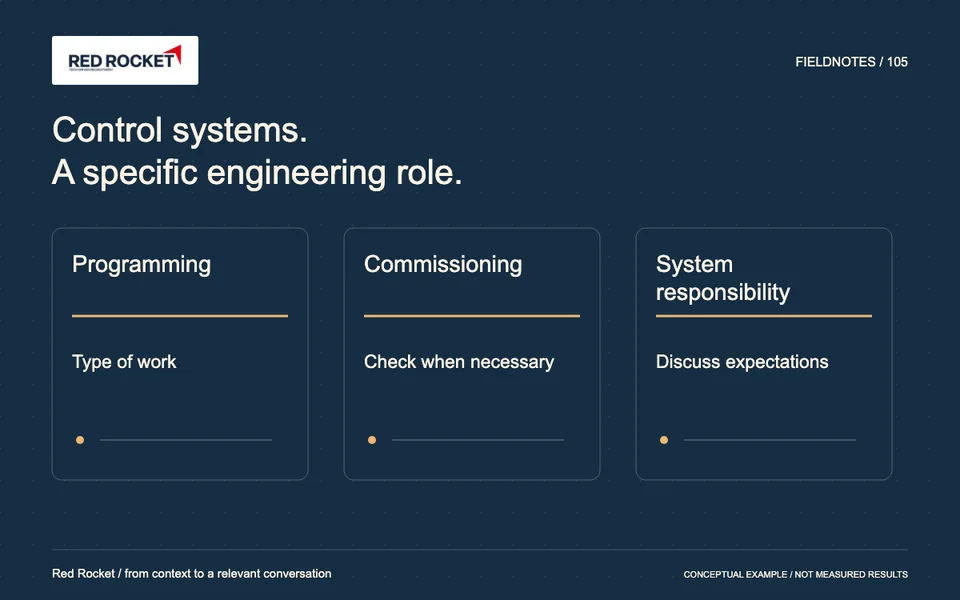
The distinction seems subtle but determines who applies. A PLC programmer writes and tests logic within a defined project. An automation engineer may also take system responsibility, from functional design through testing and handover. Establish which responsibilities this vacancy actually includes. State this explicitly. Discuss whether the candidate’s preferred responsibilities match the mandate of the role.
Making controls and software concrete
Name the platform: Siemens TIA Portal, Rockwell Studio 5000, Beckhoff TwinCAT or whatever you use. Mention the programming languages common in your environment – ladder, structured text, function block. Candidates assess their own learning curve. That gives candidates a basis for asking about the required knowledge and the available learning time.
Commissioning, safety and travel
Many automation engineers travel for FAT at machine builders or SAT at end customers. Say how much: ten per cent of the time versus forty per cent is a significant difference. Also mention the relevant safety standards – the safety frameworks applicable to your projects. Candidates who recognise these know you take the role seriously.
Testing with a project scenario
Use a fictional but realistic scenario in the interview: a line that stops unexpectedly at startup due to a sensor conflict. Ask how the candidate diagnoses it, which tools they use and how they communicate with production. You see working method, problem-solving ability and communication style – without sharing any company secrets.
How Red Rocket approaches this
Red Rocket combines a targeted campaign with an AI recruiter that carries your organisational context: your control system, travel policy and project phase. The answers provide a starting point for targeted follow-up questions; verify important statements in the personal interview. Personal assessment and follow-up remain with you as employer or recruiter. Book a conversation to discuss what this means for your vacancy. Further reading on skills supply and demand in technical roles: CBS Skills in online vacancies 2026.
Frequently asked questions
Do I need to advertise each PLC environment separately?
Not necessarily. Name the primary environment and indicate whether experience with comparable platforms is sufficient. Candidates with transferable skills will also apply – and you assess the learning curve yourself.
How do I handle candidates who are strong in one brand but not mine?
That's an interview question, not a rejection criterion. Ask about learning curve, previous platform switches and motivation. Some engineers adapt quickly; others prefer not to. That honesty surfaces in the conversation.
What if the role combines both programming and system responsibilities?
Describe both layers explicitly and indicate which carries more weight. Candidates who can handle both are scarce – be realistic about what you genuinely need versus what would simply be a bonus.