The short answer
A recruitment plan for technical professionals works when you define four things before posting: exactly who you need, what makes your role attractive, which channels to use, and who owns each step. Measure reach, qualification and interviews separately.
Bring your role, region and essential criteria. In 30 minutes, we explore how to reach technical people who are not actively looking and which approach could fit your vacancy.
Start with the hiring question before publishing
The vacancy goes live. The phone stays quiet. That is when the real thinking starts: who do you actually need, and why would someone choose you over the company down the road?
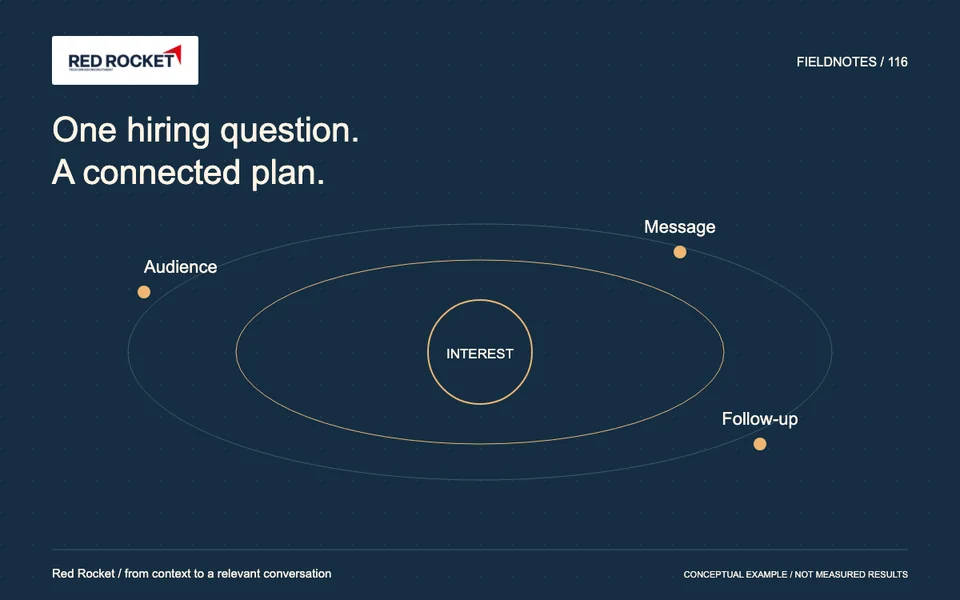
Too late. A recruitment plan for technical professionals, whether you are hiring a project manager, BIM coordinator or planning engineer, does not start with the job posting. It starts with a different question: what problem does this hire solve, and who would genuinely find this role attractive?
Define your target audience and the real hiring problem
Write one paragraph describing who you need and why that person is hard to find right now. Not "five years of experience and a hands-on attitude", but specific: someone who reads a bill of quantities independently, manages a schedule and coordinates subcontractors without daily check-ins.
Imagine fictitious mechanical contractor Oosterdam Techniek (a made-up example) needs a second planning engineer because project growth has outpaced current capacity. The hiring problem is not "we need someone". It is: lead times are stretching because one department cannot keep up with growth. That distinction shapes who you look for, what you offer and how urgently you communicate.
Also define what a good conversation looks like: a candidate who understands what you do, fits the stage of your business and is available at a realistic point in time.
Employer promise: what makes your role stand out to engineers?
A candidate may be comparing several employers. What do you say that the others do not?
An employer promise works best when it is concrete and verifiable. Not "a dynamic environment with plenty of development opportunities", but: projects averaging eight months, direct access to the director, your own budget for tools and software.
Gather evidence. What do colleagues already doing this work say about it? Are there reference projects you can name? Which tools or methods do you use that matter to this audience? Evidence is what separates a promise that sounds like every other from one that actually sticks.
Channels, ownership and follow-through: who does what?
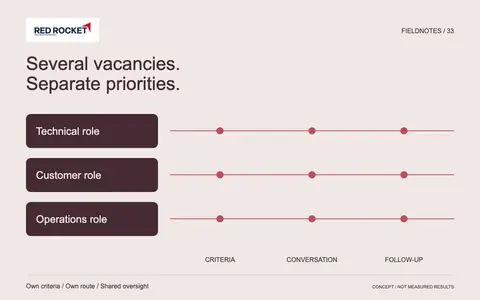
A plan without named owners is a document no one reads. Assign responsibility for each task.
- HR or recruitment: job posting, initial qualification and scheduling interviews.
- Hiring manager: technical assessment, feedback within two working days, go/no-go after the first interview.
- Marketing (where applicable): visuals, social posts and budget management for paid channels.
Budget: work from an explicit assumption. Fictional planning example, not budget advice: €500 to €1,000 in monthly media spend. Choose the channels and amounts for your specific vacancy. At Red Rocket, the standard is no cure no pay, with a recruitment fee starting at 11% of annual salary. Agree the exact percentage and salary basis in advance. Your own time is a separate cost. These are assumptions you adjust as results come in, not guarantees.
Follow-through: who calls a candidate back when the hiring manager is unavailable? Who sends the rejection? Without concrete answers, these things fall through.
Measuring what matters: reach, qualification and interviews separately
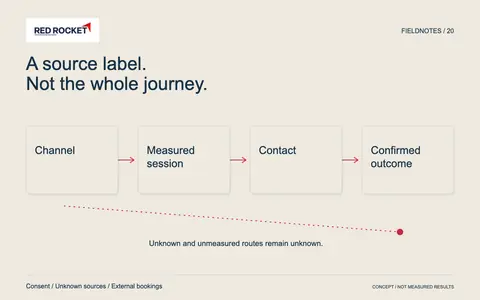
Keep three things separate in your measurement plan: reach (how many people see the vacancy), qualification (which responses meet the agreed criteria based on the collected information), booked interviews and eventual hires. Each tells you something different. A problem in reach calls for a different fix than a problem in qualification.
Set one hypothesis per recruitment cycle. Example: LinkedIn generates more qualified responses than Indeed for BIM profiles in the Utrecht region. Then change one variable, channel, copy or audience setting, and measure again. Changing several things at once makes it harder to identify what caused a difference.
For further reading on structured recruitment methods: the CIPD Recruitment Factsheet covers international HR frameworks for hiring and selection.
Want to work through this for a specific vacancy? Book a conversation with Red Rocket, no strings attached.
Frequently asked questions
What is a realistic budget for recruiting an engineer?
It depends on the role and approach. At Red Rocket, the no cure no pay recruitment fee starts at 11% of annual salary; agree the exact percentage and salary basis in advance. For paid campaigns, set an explicit assumption, for example €500 to €1,000 in monthly media spend, and adjust based on results. Your own time is a separate cost to factor in.
How do I get the hiring manager involved in the recruitment plan?
Give them a defined role with a clear deadline: feedback within two working days, a briefing before the first interview and an agreed moment for go/no-go. Without that structure, the hiring manager defaults to reactive involvement.
When is a recruitment plan finished?
Never permanently. A plan is ready to use when it has a defined target audience, a concrete employer promise, clear channel choices, a named owner for each task and an agreed measurement approach. After one cycle, you update it based on what you learned.