The short answer
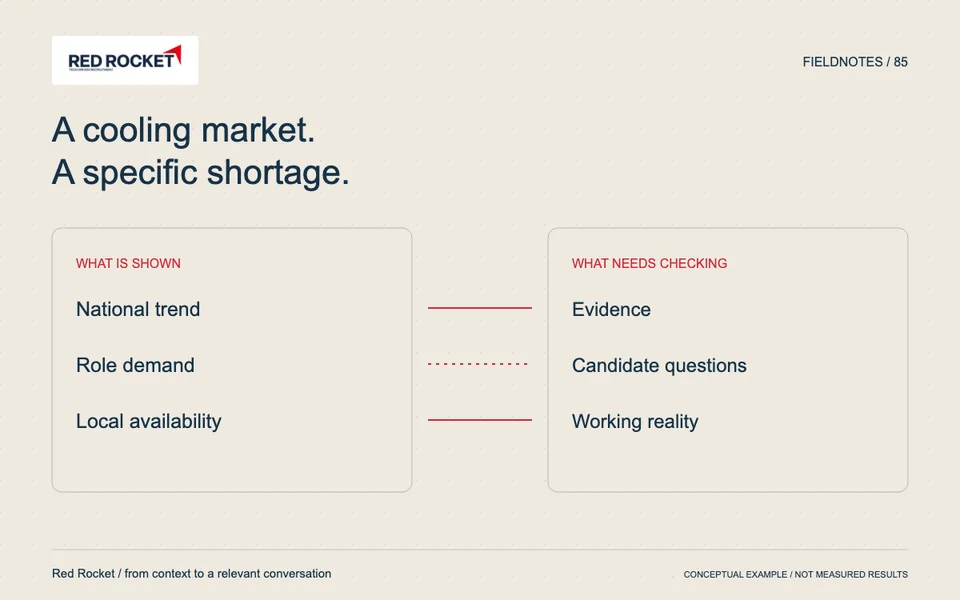
Headline labour market figures mask significant differences between occupational groups and regions. Technical management – work preparers, site managers, project leads – operates in its own sub-market with structurally limited supply. Cooling at macro level does not mean your specific vacancy becomes easier to fill. The explanation lies in the combination of occupational profile, local availability, and the channel you use to reach the market.
Bring your role, region and essential criteria. In 30 minutes, we explore how to reach technical people who are not actively looking and which approach could fit your vacancy.
Macro figure versus occupational group
When labour market reports describe cooling conditions, they describe an average across hundreds of occupations. Technical management sits in a category with structurally few active jobseekers. Tension in this sub-market follows its own rhythm – independent of what the general indicator shows. Think of it as a national weather forecast while you already know whether it's raining in your specific city.
Local availability outweighs national supply
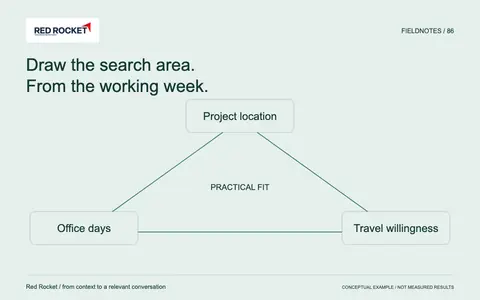
A work preparer based in one region is not automatically open to a role elsewhere in the country. Availability is geographically fragmented. Even if national supply rises slightly, your region may lag behind. Local project density, competing employers, and commute willingness together determine how many candidates are realistically reachable for your vacancy.
Vacancy volume as a signal
Look at how many comparable vacancies are currently open in your region. A high number of simultaneous openings across different employers is a direct indicator of tightness – regardless of what the macro figure says. High vacancy volume alongside limited visible candidates confirms you are operating in a tight sub-market, even as the broader market eases.
Role context sharpens the target group
Technical management is not a homogeneous group. A work preparer in utility construction has a different profile from a site manager in civil engineering. The more specific the required background, the smaller the pool. Organisational context – project scale, clients, team composition – partly determines which segment of the market is actually relevant for your vacancy.
Channel and approach make the difference
Technical management rarely responds to standard job boards. Many professionals are latently available: not actively searching, but receptive to the right conversation. Red Rocket combines targeted campaigns with an AI recruiter that incorporates organisational context, ensuring the approach connects with what this audience cares about. Personal assessment and follow-up remain with you as employer or recruiter. Book a conversation to test how your vacancy sits in the current sub-market. Further background on labour market developments is available at UWV Labour Market Information – Tension Indicator.
Frequently asked questions
Does a cooling labour market make recruitment easier?
That does not automatically follow from the overall figure. Supply and demand can differ by technical occupation and region. Examine the specific sub-market and your offer.
How do I know whether my vacancy sits in a tight sub-market?
Look at the number of comparable vacancies currently open in your region. Many competing openings alongside few visible candidates is a reliable signal of local tightness.
Why does organisational context matter when recruiting technical management?
Technical professionals make deliberate choices about projects, clients, and teams. The more concretely you communicate that context, the better you connect with what drives them – and the more relevant your vacancy becomes.